
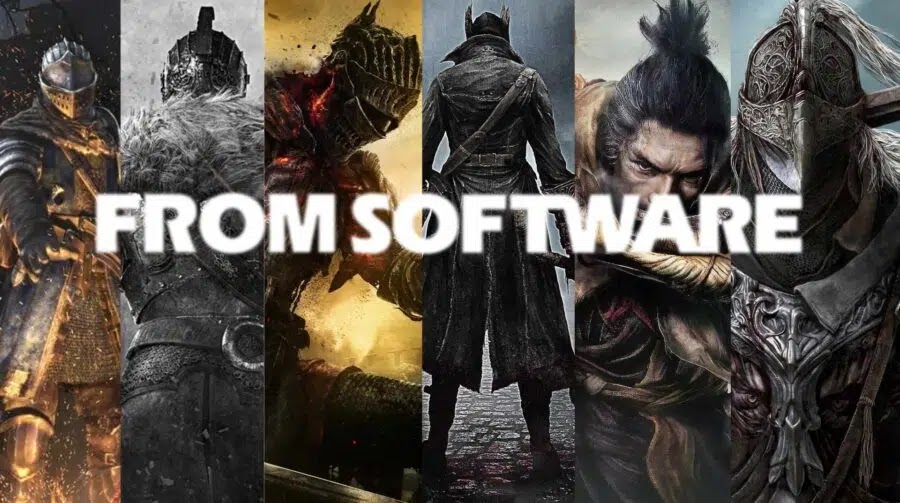

Upon learning about what later became Demon’s Souls, Miyazaki became excited at the prospect of a fantasy action role-playing game and offered to help. The project, up until he was assigned to it, was considered a failure by the company. He believed the company’s outlook on the game allowed him to take full control of the project, as any further failed ideas would not hurt it. Although the game received a negative reception at the 2009 Tokyo Game Show and sold far below expectations upon release, it began to pick up after a few months. It soon found publishers willing to release it outside Japan. After the success of the game’s spiritual successor, Dark Souls, released in 2011, Miyazaki was promoted to company president in May 2014. It was considered unprecedented for a person in Japan to change careers and become a company president within 10 years.
The multiplayer mechanics of the Souls series were inspired by his own personal experience of driving up a snowy road as cars ahead began slipping back and were pushed uphill by other people in the area. As Miyazaki was unable to give his thanks before they left the area, he wondered whether the last person in the line had made it to their destination, as he was unlikely ever to meet them again. This gave rise to the series’ multiplayer systems, which attempt to emulate that same sense of silent cooperation.
Hidetaka Miyazaki, president of FromSoftware, redefined modern gaming by prioritizing punishing difficulty, environmental storytelling, and exploration over hand-holding tutorials, influencing a generation of Action-RPGs. His work—Demon’s Souls, Dark Souls, Bloodborne, Sekiro, and Elden Ring—created the “Soulslike” genre, emphasizing deep combat mechanics, rewarding perseverance, and interconnected world design, influencing game design philosophies across the industry.
Miyazaki’s Inspirations


Ico (stylized in all caps) is a 2001 action-adventure video game developed and published by Sony Computer Entertainment for the PlayStation 2. It was designed and directed by Fumito Ueda, who wanted to create a minimalist game based on a “boy meets girl” concept. Originally planned for the PlayStation, Ico took approximately four years to develop. The team employed a “subtracting design” approach to reduce gameplay elements that interfered with the game’s setting and story, thereby creating immersion.
Berserk is a Japanese manga series created by Kentaro Miura. Set in a medieval Europe–inspired dark fantasy world, the story centers on the swordsman Guts and Griffith, the leader of a mercenary group called the Band of the Hawk. The series follows Guts’ journey seeking revenge on Griffith, who betrayed him and the rest of their comrades.
Legend of Zelda centers on the various incarnations of Link, a courageous young man of the elf-like Hylian race, and Princess Zelda, a princess of the bloodline of the goddess Hylia. They fight to save the land of Hyrule from Ganon, an evil warlord turned demon king who wishes to use the Triforce, a sacred relic that can grant any wish its user desires when complete, to remake the world in his own dark image. Zelda’s role has often been that of a damsel in distress or donor who assists Link.
FromSoftware wanted to create an open-world game based on Dark Souls. Miyazaki admired Martin’s previous work and hoped that his contributions would yield a more accessible narrative than the company’s earlier games. Martin was given freedom to design the backstory, while Miyazaki acted as lead writer for the in-game narrative. The developers concentrated on environmental scale, stat management, and the story; the scale required constructing several structures within its world.
FromSoftware lore is famously obscure, often requiring players to piece together a fragmented narrative through environmental storytelling, item descriptions, and NPC dialogue. Rather than using traditional cutscenes for exposition, the studio focuses on a “show, don’t tell” approach that emphasizes the player’s role in uncovering a world’s history. FromSoftware achieved breakout success in the 2010s, spurred by the release of Demon’s Souls (2009) and Dark Souls (2011), the latter being the first entry in a trilogy whose success helped create a subgenre of action role-playing games known as Soulsborne games. These include Dark Souls II (2014), Bloodborne (2015), Dark Souls III (2016), Sekiro: Shadows Die Twice (2019), and Elden Ring (2022), all of which have received several awards and are often listed among the greatest video games of all time.]In April 2014, Kadokawa Corporation announced its intention to purchase the company from former shareholder Transcosmos. Following other restructuring, Souls creator Hidetaka Miyazaki would be promoted to company president the following month and later given the title of representative director. In January 2016, FromSoftware established a studio in Fukuoka that focuses on creating computer-generated imagery (CGI) assets for their games.


The Most Recent Nominated Game Rewards
Elden Ring won several Game of the Year awards and has been cited as one of the greatest games of all time, with praise directed towards its open world, gameplay systems, and setting. It sold over 30 million copies, also making it one of the best-selling games of all time. The downloadable content (DLC) Shadow of the Erdtree follows the player character in the Land of Shadow. It was released in June 2024 to similar acclaim and sold over ten million copies.
The team works from rough maps and concepts in the early stages, allowing for quick adjustments to level design before finalizing details. Miyazaki has worked to improve the work environment at FromSoftware, focusing on reducing physical exhaustion and improving pay, particularly for younger staff. He believes his team makes him stronger, emphasizing the importance of mutual inspiration in completing large-scale projects. Especially with Elden Ring, a key focus is offering a high degree of freedom, allowing players to explore a vast, unknown world at their own pace. The team aims for “fair difficulty” where players understand why they failed and feel motivated to improve, often through learning patterns and exploring alternatives.